
After Effects CC 2014 (13.0) does not include exporters for creating H.264, MPEG-2, and WMV videos directly from the render queue. To create videos in these formats, you should use Adobe Media Encoder.
After Effects Mp4 Codec
You can still import videos in these formats into After Effects.
Issue: How do you create H.264, MPEG-2, and WMV videos using Adobe Media Encoder with After Effects?
You have two primary options for using Adobe Media Encoder with After Effects to create videos in H.264, MPEG-2, and WMV formats.
Solution 1: render and export a losslessly encoded master file out of After Effects to a watch folder monitored by Adobe Media Encoder
Jul 17, 2020 Better PC Configuration for After Effects. Stepping up a bit in terms of performance, the Intel Core i9 10900K 10 core is a bit faster than the Core i7 10700K and is currently the fastest CPU for After Effects from both Intel and AMD before you get to the significantly more expensive AMD Threadripper processors. Download h264 codec after effects. 1,277 views 0 comments. Post not marked as liked. Recent Posts See All. Download lulubox apk terbaru. Post not marked as liked.
The fastest way to create videos in these formats using Adobe Media Encoder with After Effects is to use the After Effects render queue to export a losslessly encoded master file (e.g., using the PNG video codec in a QuickTime .mov container file) to a watch folder that Adobe Media Encoder monitors. You can assign encoding presets to a watch folder in Adobe Media Encoder so that it automatically encodes using whichever settings you have specified.
One advantage of using this method is that it uses After Effects performance features for rendering (such as GPU acceleration and multiprocessing where applicable) and Adobe Media Encoder performance features for encoding (such as parallel encoding). The disadvantage of using this method is that it occupies the main After Effects application for the entire rendering operation, during which time you can’t use After Effects for anything else.
Solution 2: send the composition directly to Adobe Media Encoder from After Effects (Composition > Add To Adobe Media Encoder Queue)
Another method to create videos in these formats using Adobe Media Encoder with After Effects is to directly add the composition from After Effects to the Adobe Media Encoder queue.
This method has the advantage of allowing you to continue working in After Effects while the rendering and encoding takes place, since the rendering is performed by a background instance of After Effects. The rendering phase may be slower in some cases, compared with using the After Effects render queue, because the headless version of After Effects rendering in the background does not have access to GPU acceleration and multiprocessing features.
Why were these exporters removed from the After Effects render queue?
The reason the H.264, MPEG-2, and WMV exporters were removed from the After Effects render queue is simple: Maintaining these exporters in After Effects took quite a lot of work, and fixing several significant bugs in these exporters would take even more work. Work would have subtracted from other resources.
Since Adobe Media Encoder already had superior H.264, MPEG-2, and WMV exporting capabilities, it was more prudent to rely on Adobe Media Encoder for export of these formats, allowing the After Effects team to focus efforts on animation, motion graphics, compositing, and digital imaging features—which core areas for After Effects.
One thing that makes Adobe Media Encoder so much better than After Effects for creation of files in final delivery formats is its Preset Browser and easy-to-use system for creating, saving, sharing, and applying encoding presets. Another is the assortment of features in the Effects tab with which you can automatically add watermarks, timecode overlays, et cetera.
What if I still need to create these kinds of videos from the After Effects render queue?
If you still need to be able to create videos in these formats from the After Effects render queue for some reason, you can still do so by leaving After Effects CC (12.2.1) installed alongside After Effects CC 2014 (13.0) and using the previous version for these specific output tasks.
For more details, see this blog post.
Top image via Shutterstock
It’s time to add another notch to your After Effects belt. After this quick how-to, you’ll know how to export H.264 video in only six easy steps!
Step 1. Go to Composition and Click “Add to Render Queue”
In the menu structure, click on Composition and select Add to Render Queue. (Alternatively you can use the keyboard shortcut Control+Command+M.)
Step 2. Open Output Module, Set Format to QuickTime
Click on the blue text next to Output Module to open the menu. Change the Format to QuickTime.
H264 After Effects Cc 2017
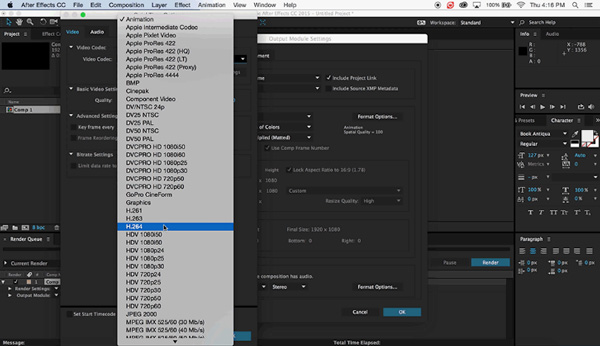
Step 3. Click “Format Options,” Set Video Codec to H.264, Set Quality to 100
Open the Format Options… menu list. Under the Video tab, change the Video Codec to H.264, set Quality to 100. Click OK, and then click OK again.
Step 5. Open “Output To,” Set Your Project Save Settings
Click the blue text next to Output To, add your project name and destination location, click Save
Step 6. Click Render
After Effects Codec
H264 After Effects Cc
Click the Render button and you’re done. No problem!
Sign In
Register
- Access to orders in your account history
- Ability to add projects to a Favorites list
- Fast checkout with saved credit cards
- Personalized order invoices
Create Account